📸 Case #3: The Yogurt-Stealing Golden Retriever—The Fridge Burglar
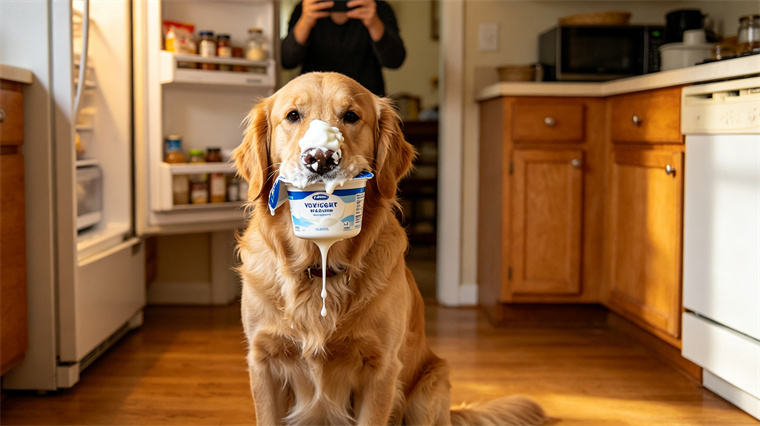
[Image Description] Another famous snapshot: A Golden Retriever sits on the kitchen floor in front of an open refrigerator door (the door itself remains undamaged, indicating that the dog successfully learned to pry it open using its nose or paws). Clutched in the Golden Retriever's mouth is an entire container of Greek yogurt; the lid has already been bitten open, and white yogurt can be seen dripping down the sides of the container.
Its face was smeared with yogurt, and there was a large dollop right on the tip of its nose. The owner stood on the other side of the fridge taking photos, adding the caption: "The food in my fridge kept mysteriously disappearing, so I installed a camera. It turns out the culprit was my Golden Retriever. It even knows how to close the fridge door—well, no, it doesn't actually close it; it's just incredibly greedy."【Behavioral Analysis】 Golden Retrievers are widely recognized as "gourmets"; their noses can precisely pinpoint high-value food items inside the fridge. The solution is to install a child lock on the refrigerator or place a physical barrier in front of it.
📸 The cases above capture those spectacular moments when our furry friends are "caught in the act." Next, we will analyze—from a scientific perspective—the five major underlying causes behind these behaviors.
🧠 II. Why Do Dogs Like to "Steal Things"? — 5 Major Behavioral Roots
To solve a problem, one must first understand the motivation behind it. According to statistics from the American Veterinary Society of Animal Behavior (AVSAB), over 68% of pet dogs have engaged in "stealing" human belongings at least once. Here are the five core reasons:
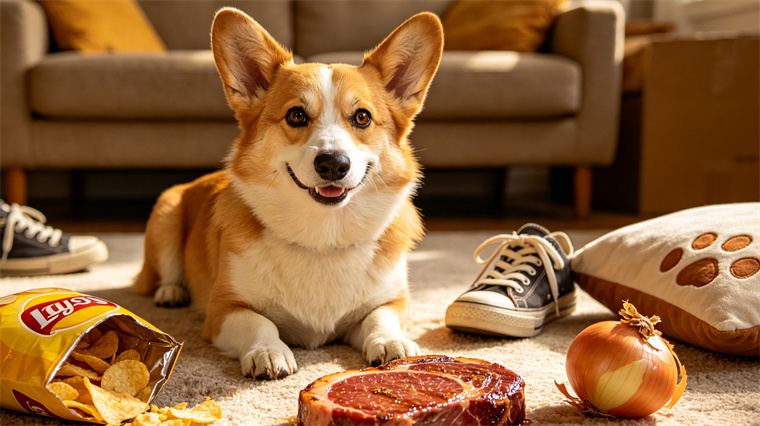
- 🔍 Exploratory Instinct: Dogs primarily explore the world using their mouths. This is especially true for puppies (aged 6–18 months), for whom chewing on and carrying off objects is a normal part of cognitive development. The "chip-bag puppy" in Case #2 is a classic example of this exploratory behavior.
- 🎁 Seeking Attention: If a dog discovers that "stealing a sock" immediately triggers its owner to chase after it or shout (even if it's a reprimand), it will interpret this as an interactive game. Lloyd, the dog in Case #34, acts so "shamelessly" because he has learned that stealing a steak invariably guarantees him immediate attention from his owner.
- 🍖 Food-Driven: The scent of meat, bread, yogurt, and other items in the kitchen holds an appeal for dogs that is far greater than you might imagine. Case #16: The Onion Thief—onions are toxic to dogs, yet dogs are guided solely by scent and pay no heed to health risks.
- 😰 Separation Anxiety: When their owners leave, dogs may attempt to alleviate their anxiety by carrying off items that carry their owner's scent (such as shoes or hats). Case #3—the dog with a 14-year habit of stealing shoes—likely demonstrates a behavioral component rooted in emotional self-soothing.
- 🧬 Breed Genetics: Retrievers possess a natural inclination to carry objects in their mouths; sled dogs enjoy destructive activities and transporting items; and herding dogs excel at problem-solving. Case #22 (the Husky stealing pillows) and Case #24 (the German Shepherd dismantling a car bumper) both serve as prime examples of these genetic instincts in action.
🐾 Key Insight: Dogs do not possess a moral concept of "theft"; their behavior is governed solely by the animalistic logic that "benefits > risks." If an item is successfully carried off and results in enjoyment, that specific behavior becomes reinforced. Case #13—the "Trader" dog—is a perfect example of a dog that independently discovered the cause-and-effect relationship between "carrying an item" and "receiving a treat."